
Signs of Snoring You Need To Be Cautious About


You wake up tired. Again. Not the kind of tired that coffee fixes, the kind that sits behind your eyes all morning. Maybe someone told you that you snore. Maybe no one has said a word, and you have simply started to wonder.
In many Malaysian households, snoring is treated like a family trait, something you live with, not something you treat. That assumption is worth revisiting.
Key Takeaways
Snoring produces recognizable signs during the day: dry throat, fatigue, and morning headaches. You do not need a partner to self-identify.
Snoring accompanied by gasping, witnessed breathing pauses, or significant daytime sleepiness may indicate obstructive sleep apnea (OSA) and warrants medical evaluation.
Non-surgical laser treatment (Fotona NightLase) is available in Malaysia: no anesthesia, no recovery time, approximately 20 minutes per session.
How Do You Know If You're Snoring? Day and Night Signs

Source: Freepik
Snoring occurs when airflow causes the soft tissues of the throat, the soft palate, uvula, and tongue to vibrate during sleep. The signs fall into two categories: nighttime signs observed by a partner or recorded by a phone app, and daytime signs that the snorer can identify themselves.
Most snorers rely on a partner to tell them. But snoring rarely causes a full awakening. Disruption happens through micro-arousals that fragment sleep without reaching conscious memory, which is why daytime symptoms are often the snorer's only reliable signal.

You Notice During the Day | A Partner or App Catches at Night |
Dry or sore throat on waking | Loud rattling or vibrating sounds |
Morning headaches | Snorting or gasping sounds |
Fatigue despite adequate sleep hours | Restless movement or frequent position changes |
Difficulty concentrating or brain fog | Witnessed pauses in breathing |
Mood irritability or low patience | Mouth open throughout sleep |
If three or more of these daytime signs sound familiar, your body is giving you a signal worth taking seriously. Poor sleep and skin health are closely linked too: disrupted sleep is one of the more overlooked drivers of skin dullness and under-eye changes.
⭐⭐⭐⭐⭐
Lim Khai Xuen
"Thank you to doctor eunice, meijo and sofea. Recommended."

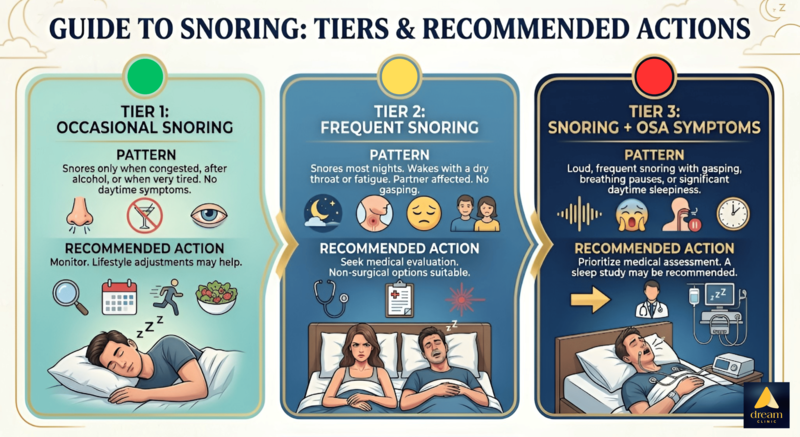
Not sure which tier describes your snoring?
Dream Clinic's LCP-certified doctors can assess your symptoms and tell you exactly where you stand. Consultations are available at our Penang, Kuala Lumpur (Bukit Jalil), and Johor (Iskandar Puteri) branches.
Book your consultation today.
When Snoring Becomes a Health Warning, Not Just a Noise Problem

Source: Freepik
Not all snoring carries equal health risk. When snoring is frequent, loud, and accompanied by specific red flags, particularly gasping, observed breathing pauses, or significant daytime sleepiness, it may indicate obstructive sleep apnea (OSA): a condition with documented links to hypertension and cardiovascular disease.
Most snoring is not dangerous. The goal here is not to alarm but to help you identify the threshold that matters.
The red flags that cross the line:
Observed pauses in breathing: The most clinically significant nighttime sign. It indicates actual cessation of breathing, not just tissue vibration.
Gasping or choking sounds: Suggests the airway is being intermittently blocked and the body is correcting itself.
Excessive daytime sleepiness (EDS): Distinct from ordinary tiredness. This includes falling asleep unintentionally in passive situations: meetings, reading, and watching TV.
Recurring morning headaches: Particularly those that resolve within an hour of waking.
Research published in Current Cardiology Reports established that OSA is independently associated with elevated hypertension and cardiovascular disease risk. A systematic review in Diseases notes that OSA is characterized by intermittent nocturnal hypoxemia and excessive daytime sleepiness as its hallmark features.
If a partner witnesses any of these signs, documenting them via voice or video recording is useful to bring to a doctor. Research also shows that dark circles from sleep deprivation can be a visible sign of chronically disrupted sleep, worth noting alongside snoring symptoms.
Why Malaysians Often Wait Too Long to Seek Help
Cultural normalization of snoring delays diagnosis in Malaysian households, often by years: a pattern Dream Clinic's LCP-certified doctors observe regularly.
This delay compounds health risks because snoring, which begins as a mild airway issue, can progress to more significant sleep-disordered breathing when left unaddressed.
In many Malaysian families, snoring is accepted as a generational trait, particularly among male family members. Seeking treatment can feel unnecessary, even excessive.
Malaysia's tropical environment adds another layer. Nasal congestion from dust allergies, prolonged air-conditioning exposure, and seasonal haze all worsen snoring by narrowing the nasal airway and increasing the workload on throat tissues. This is a context that Western medical content rarely addresses.
Myth | Fact |
"Everyone in my family snores, it's just how we are." | Genetics may create a predisposition, but anatomy, sleeping position, and lifestyle habits are the primary drivers. These can be addressed. |
"If I felt seriously tired, I'd know." | Habitual snorers adapt to chronic fatigue so gradually they no longer recognize it as abnormal. |
"Treatment means surgery or wearing a machine every night." | Non-surgical Fotona NightLase takes approximately 20 minutes per session: no anesthesia, no recovery time. |
If you are exploring whether lifestyle changes can help first, this guide on how to stop snoring covers the practical factors worth addressing before or alongside treatment.
⭐⭐⭐⭐⭐
Wan En Ooi
"Great experience at Dream Clinic! Dr. Vera is very attentive, and the team—Meijo and Syu—work seamlessly together. I felt safe trusting them with my face and skin. Highly recommended!"
Ready to find out if NightLase is right for you?
Dream Clinic's LCP-certified doctors offer personalized consultations for snoring treatment in Malaysia at our Penang, Kuala Lumpur, and Johor branches. No commitment required, just clarity on where you stand and what your options are.
Book your snoring treatment consultation with us now.
What You Can Actually Do About It
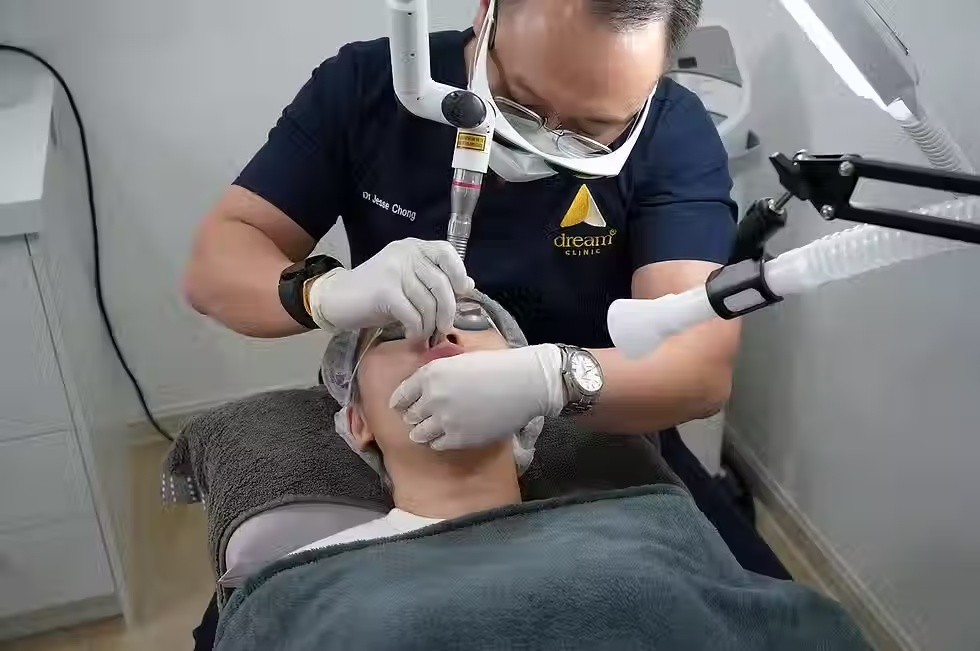
For mild to moderate snoring, Fotona NightLase offers a clinically studied, non-surgical treatment option: Er:YAG laser energy in SMOOTH mode gently heats the soft palate and throat tissues, stimulating collagen contraction and tightening the airway. No incisions, no anesthesia, no recovery time.
Think of it as structural firming for the airway: the laser tightens lax throat tissues, just as collagen-stimulating treatments firm sagging skin elsewhere. For a fuller overview of the technology behind it, see what to know about Fotona laser.
A randomized controlled trial published in the European Archives of Oto-Rhino-Laryngology found that NightLase significantly reduced snoring intensity compared with sham treatment, required no local anesthesia, and caused no complications in 40 patients.
The study involved patients with primary snoring and mild sleep apnea. NightLase is not a substitute for specialist management in severe OSA cases.
NightLase is suitable for patients who are:
Finding it hard to sleep well due to snoring or mild sleep apnea
Wanting to improve breathing and reduce airway obstruction at night
Concerned that snoring is affecting their health or disturbing loved ones
What to expect: A standard course involves three sessions over six to eight weeks. Most patients experience a meaningful reduction in snoring after completing the full course. Results typically last up to 12 months; maintenance sessions can sustain them.
Learn more about snoring treatment in Malaysia and what to expect at your first consultation. Dream Clinic's laser treatment for snoring article also covers the full procedure in detail.
Fotona NightLase | CPAP Machine | Surgery | |
Invasive? | No | No | Yes |
Anesthesia required? | No | No | Yes |
Recovery time | None | None | Days to weeks |
Session time | ~20 minutes | Every night | One-time procedure |
Device to wear to bed? | No | Yes (nightly) | No |
Best for | Primary/mild-moderate snoring | Moderate-severe OSA | Structural obstruction |
⭐⭐⭐⭐⭐
李恩慈
"Thank you Dr Eunice and Manisha for the service , patience, kind and professional. Thanks to Mei Jo for handling the payment, will visit again soon."
Source: Dream Clinic Facebook
Why Dream Clinic

Dream Clinic is an aesthetic clinic with branches in Penang, Kuala Lumpur (Bukit Jalil), and Johor (Iskandar Puteri), making consultation and follow-up accessible across Malaysia.
All NightLase treatments are performed by skin specialist Penang and LCP-certified doctors with clinical experience assessing snoring and sleep-disordered breathing
KKM is licensed under Malaysia's Ministry of Health framework.
Fotona laser technology is FDA-approved: the same platform trusted by clinics internationally
500+ five-star Google reviews from patients across all three branches.
Every patient begins with a clinical consultation. Doctors assess whether NightLase is appropriate before any treatment is recommended
Three convenient locations in Penang, Kuala Lumpur (Bukit Jalil), and Johor (Iskandar Puteri).
Conclusion
Snoring is widely dismissed in Malaysia, but the signs are there, and so are the solutions. If the daytime symptoms in this article sound familiar, your body has been signaling you. A brief consultation with an LCP-certified doctor is all it takes to know where you stand.
Seen enough to take the next step?
A single consultation with one of Dream Clinic's LCP-certified doctors is all it takes to confirm whether NightLase is right for you. Available across Penang, Kuala Lumpur (Bukit Jalil), and Johor (Iskandar Puteri).
Book your snoring treatment consultation now.
Ready to stop guessing? Book a consultation with an LCP-certified doctor at our aesthetic clinic in Penang, Kuala Lumpur, or Johor.
Penang Branch: 2, Jalan Lima, Tanjung Tokong, 10470 Tanjung Bungah, Pulau Pinang
KL Branch: D-03-1, Pusat Perdagangan Bandar, Persiaran Jalil 2, Bukit Jalil, 57000 Kuala Lumpur
Johor Branch: No. 31 (Ground Floor), Jalan Eko Botani 3/7, Taman Eko Botani, 79100 Iskandar Puteri Johor. (Temporarily closed)
FAQs
Q1. What are the signs of snoring?
Signs of snoring include waking with a dry or sore throat, morning headaches, persistent daytime fatigue despite adequate sleep, difficulty concentrating, and mood irritability. Nighttime signs, observed by a partner or a recording app, include loud rattling sounds, snorting, and restless sleep.
Daytime signs are particularly useful for solo sleepers. Not all snoring indicates a medical problem: frequency and accompanying symptoms determine severity.
Q2. When should I be worried about snoring?
Snoring warrants medical attention when it is loud and frequent, or accompanied by gasping or choking sounds, witnessed pauses in breathing, recurring morning headaches, or significant daytime sleepiness.
These signs suggest airway obstruction is disrupting sleep architecture or indicating obstructive sleep apnea. Occasional snoring without daytime symptoms is low-risk. Frequent snoring with fatigue warrants evaluation. Snoring with gasping or breathing pauses requires prompt assessment.
Q3. Does snoring mean I have sleep apnea?
Not necessarily. Snoring is the most common symptom of obstructive sleep apnea, but many people snore without having OSA. If snoring is accompanied by witnessed breathing pauses, gasping sounds, or excessive daytime sleepiness, a medical evaluation is recommended to rule out OSA.
A formal diagnosis requires a sleep study. NightLase is suitable for primary snoring and mild OSA: it is not a substitute for OSA management in severe cases.
Q4. What is Fotona NightLase and how many sessions does it take?
Fotona NightLase is a non-surgical laser treatment that uses Er:YAG laser energy to tighten the soft palate and throat tissues, reducing snoring without anesthesia or downtime.
A standard course involves three sessions over six to eight weeks. Most patients see meaningful improvement after completing the full course. Results typically last up to 12 months and can be maintained with follow-up sessions. Learn more at Dream Clinic's snoring treatment in Malaysia page.
References
1. Abu Salman, L., Shulman, R., & Cohen, J. B. (2020). Obstructive sleep apnea, hypertension, and cardiovascular risk: Epidemiology, pathophysiology, and management. Current Cardiology Reports, 22(2), 6. https://link.springer.com/article/10.1007/s11886-020-1257-y
2. Mitra, A. K., Bhuiyan, A. R., & Jones, E. A. (2021). Association and risk factors for obstructive sleep apnea and cardiovascular diseases: A systematic review. Diseases, 9(4), 88. https://www.mdpi.com/2079-9721/9/4/88
3. Picavet, V. A., Dellian, M., Gehrking, E., Sauter, A., & Hasselbacher, K. (2023). Treatment of snoring using a non-invasive Er:YAG laser with SMOOTH mode (NightLase): a randomized controlled trial. European Archives of Oto-Rhino-Laryngology, 280(1), 307–312. https://link.springer.com/article/10.1007/s00405-022-07539-9


