Why Does Your Face Look Saggy Even Though Your Skin Looks Healthy?


Key Takeaways
Facial firmness depends on three layers: the skin surface, the dermal elastic matrix (collagen and elastin), and deeper structures such as fat pads, ligaments, and bone. A skincare routine only reaches the first two.
Facial sagging is not driven by body weight. Fat compartments in the face shrink and shift gradually with age, often becoming noticeable from the mid-30s in many people, with the midface and jawline usually showing it first.
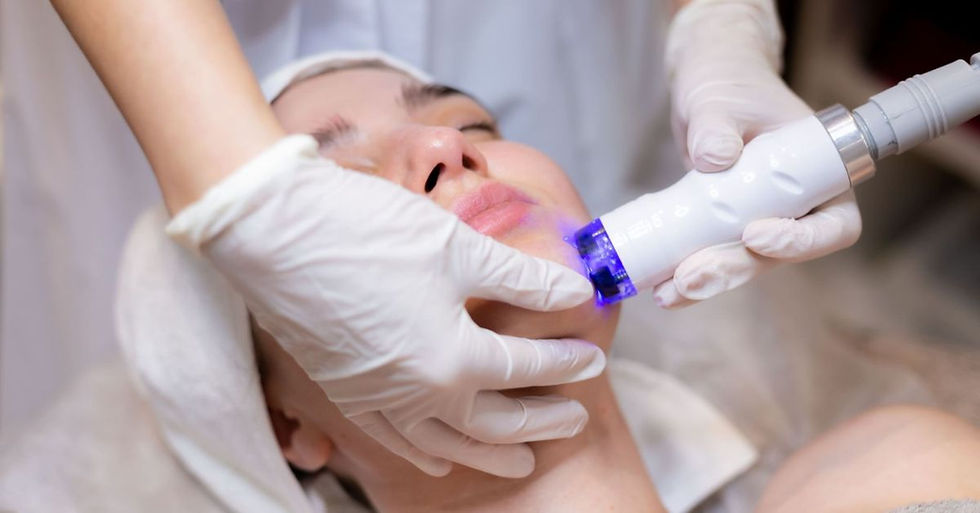
Non-surgical facial lifting treatments, such as Titanium Lifting, may help improve the appearance of early to moderate sagging in appropriately selected patients. The right treatment depends on which layer of facial structure is driving the change.
What Are the Three Layers Behind a Firm Face?
Facial firmness depends on three layers working together: the skin surface, the dermal elastic matrix beneath it, and the deeper structural scaffold of fat pads, ligaments, muscle, and bone. A skincare routine addresses only the first layer, which is why healthy-looking skin does not guarantee a firm facial structure.
The skin surface covers tone, texture, hydration, and pigmentation. A good cleanse, sunscreen, retinoid, and the occasional medifacial can take this layer a long way. A face can score well here and still sag.
Dermal elasticity comes from the collagen and elastin matrix beneath the skin surface, which gives skin its recoil. Production slows gradually from the mid-to-late 20s, so skin takes a little longer each year to bounce back after being pulled or creased. Topical treatments and some energy-based procedures can support this layer, but they cannot fully restore it.
Structural support is the deepest layer, and the one skincare cannot reach. Youthful fat compartments keep the midface plump, retaining ligaments hold tissue in position, and underlying facial bone provides the architecture. When this scaffold shifts, the face loses its shape even if the skin above still looks clear.
If your skin passes the mirror test but your face still looks tired, the change is likely happening in the dermal elasticity or structural support layers.
What Changes Underneath the Skin to Cause Facial Sagging?
Facial sagging results from several age-related changes happening at the same time: collagen and elastin loss, shrinking and shifting fat compartments, bone remodeling, and gradual loosening of retaining ligaments and muscle tone. Sun exposure, smoking, and weight fluctuation all speed these changes along.
UV exposure and smoking accelerate collagen and elastin decline on top of the natural slowdown already underway. Starting a wrinkle treatment earlier rather than later tends to produce more noticeable results, though outcomes vary from person to person.
Facial fat redistribution is a well-documented mechanism.
Research by Rohrich and Pessa on the face’s distinct fat compartments describes how these compartments change with age. A youthful face has evenly distributed fat compartments that keep features full and lifted; with time, fat shrinks in the temples, under-eye area, and upper cheek, and often shifts downward to add heaviness at the jowls and chin. This alone can create a sagging appearance even when skin quality has not changed.
Bone and ligament remodeling also plays a part. The orbital rim widens, the maxilla recedes, and retaining ligaments gradually loosen their hold, leaving less scaffolding to support the tissue above it.
Daily expression and gravity compound these effects as the dermal layer thins. Chronic frowning, squinting, and gravity's constant pull deepen expression lines over the years.
A few lifestyle factors speed the whole process along:
Sun exposure, especially significant at Malaysia's near-equatorial UV levels year round
Smoking
Significant weight fluctuation
Sleep debt
High-sugar diets, which may contribute to collagen glycation
Fitzpatrick III–V skin types follow their own aging pattern, one that most published research and overseas aesthetic content does not address. Asian faces may show different patterns of visible ageing, influenced by skin structure and facial anatomy.
A review on the ageing Asian face discusses differences in skeletal support and soft-tissue distribution, although findings should not be generalised to every Asian person or all Fitzpatrick III–V skin types.
Combined with a higher risk of post-inflammatory hyperpigmentation from certain energy-based treatments, this changes both how sagging presents and which treatments are appropriate for Malaysian patients.
Where Does Facial Sagging Appear First?
Facial sagging typically appears first in the midface, then progresses to the jawline, lower face, and neck as deeper structural changes continue. Recognizing which stage a face is at helps determine which type of treatment makes sense.
In the early stage, usually mid-30s to early 40s, expect faint shadowing under the eyes, a slight loss of cheek projection, and nasolabial folds that are visible even at rest. Skin still has reasonable recoil, and most patients at this stage describe looking "tired" rather than "older."
In the moderate stage, usually mid-40s onward, the nasolabial folds deepen, early jowling appears along the jawline, the corners of the mouth begin to turn down, and under-eye hollowing or bags become more noticeable.
In the established stage, usually from the 50s, jowl descent becomes visible, the clean mandibular border is lost, submental laxity appears under the chin, and folds deepen further. The neck often shows loose skin or banding.
This is a general pattern, not a fixed timeline. Genetics, sun exposure history, weight changes, and facial structure can shift it earlier or later.
The jawline often loses definition first. It lacks the strong bony support found at the forehead or cheekbones, sits over mobile fat compartments, and stays in near-constant motion from talking, chewing, and expression.
That combination explains why jawline change can show up even in patients who otherwise take good care of their skin.
Wondering which face-lifting treatment is right for your stage of sagging? Our LCP-certified doctors at Dream Clinic will assess your skin, structure, and goals during a personalized consultation, then recommend an approach suited to your face. WhatsApp us to book.
What Can Non-Surgical Facial Lifting Treat, and What Can It Not Fix?
Non-surgical facial lifting may help improve the appearance of early to moderate sagging in appropriately selected patients. It works by stimulating or supporting the body's own tissue rather than removing or repositioning it, so results tend to be more subtle than surgery. The right treatment depends on which facial layer is driving the change.
For dermal elasticity concerns, energy-based treatments that stimulate collagen remodeling are typically used. Titanium Lifting and Fotona Multi-D Lift are multi-wavelength laser treatments used at Dream Clinic to support this layer.
For mild to moderate structural concerns, High-Intensity Focused Ultrasound (HIFU) targets the deeper fascial layer, thread lifting repositions descended tissue, and Profhilo supports skin quality alongside structural treatments. A combined face-lifting treatment plan is often more effective than relying on a single device.
For more advanced structural change, such as significant jowl descent or loose neck skin, non-surgical options may not produce adequate improvement. In these cases, referring the patient to a plastic surgery consultation is usually the more appropriate and transparent next step.
Non-surgical lifting is not suitable for everyone, including during pregnancy or breastfeeding, with active skin infection in the treatment area, or with certain autoimmune conditions. Patients expecting a surgical-level result from a non-surgical treatment are also not good candidates. Suitability is always assessed individually.
The right treatment depends less on choosing the newest device and more on identifying which layer is driving the change for a specific patient, their Fitzpatrick skin type, and their goals.
Why Choose Dream Clinic

At Dream Clinic, we take a personalised, doctor-led approach to non-surgical facial lifting, matching each treatment to your facial concerns, skin type and aesthetic goals.
Experienced aesthetic doctors: Our LCP-certified aesthetic doctors are trained to assess and treat Fitzpatrick III–V skin types commonly found among Malaysian patients.
Multiple lifting treatment options: We offer a range of non-surgical lifting modalities under one roof, allowing treatments to be tailored to the specific causes and stages of facial sagging.
Established presence in Malaysia: Ranked among the Top 3 aesthetic clinics in Penang, Dream Clinic also serves patients at our Bukit Jalil branch in Kuala Lumpur and Iskandar Puteri branch in Johor.
Personalised treatment plans: Our doctors assess your facial structure, skin condition and concerns before recommending an approach suited to your needs.
Medically supervised technologies: We use FDA-approved technologies administered under appropriate medical supervision, with treatment suitability assessed for each patient.
Conclusion
Facial firmness is built from more than skin alone, which is why a well-cared-for face can still begin to lose its shape over time. Understanding which layer is changing, and which stage you are at, is the first step toward choosing a treatment that fits your face rather than someone else's. At Dream Clinic, every patient is assessed before anything is recommended.
FAQs
Q1. Why is my face sagging if I haven't gained or lost weight?
Facial sagging is driven more by loss of underlying structure than by weight change. Fat compartments shrink in the upper face, retaining ligaments loosen, and bone remodels gradually with age, often starting around the mid-30s, independently of body weight. A face can lose its shape even when the scale has not moved.
Q2. Can facial sagging be reversed without surgery?
Early and moderate sagging can often improve meaningfully with non-surgical treatments that stimulate collagen remodeling, add support, or lift descended tissue. More advanced sagging, including significant jowl descent or loose neck skin, may not respond as well, in which case a consultation with a plastic surgeon may be the more suitable option.
Q3. At what age does the face typically start to sag?
There is no single age. Most patients notice early signs between the mid-30s and late 40s, with changes becoming more visible in the 50s. Genetics, sun exposure, smoking, weight fluctuation, and skin type can all shift the timeline earlier or later.
Q4. Who should not get non-surgical facial lifting?
Non-surgical lifting is generally not suitable during pregnancy or breastfeeding, with active skin infection in the treatment area, or with certain autoimmune conditions. A doctor assessment is essential to determine suitability.
Q5. How soon will I see results from a non-surgical lifting treatment?
Most patients notice some initial tightening within a few weeks, with further improvement typically continuing over the following months as collagen remodels. Discomfort during treatment is generally mild, though this varies by treatment type, and maintenance sessions are usually recommended to extend results.