
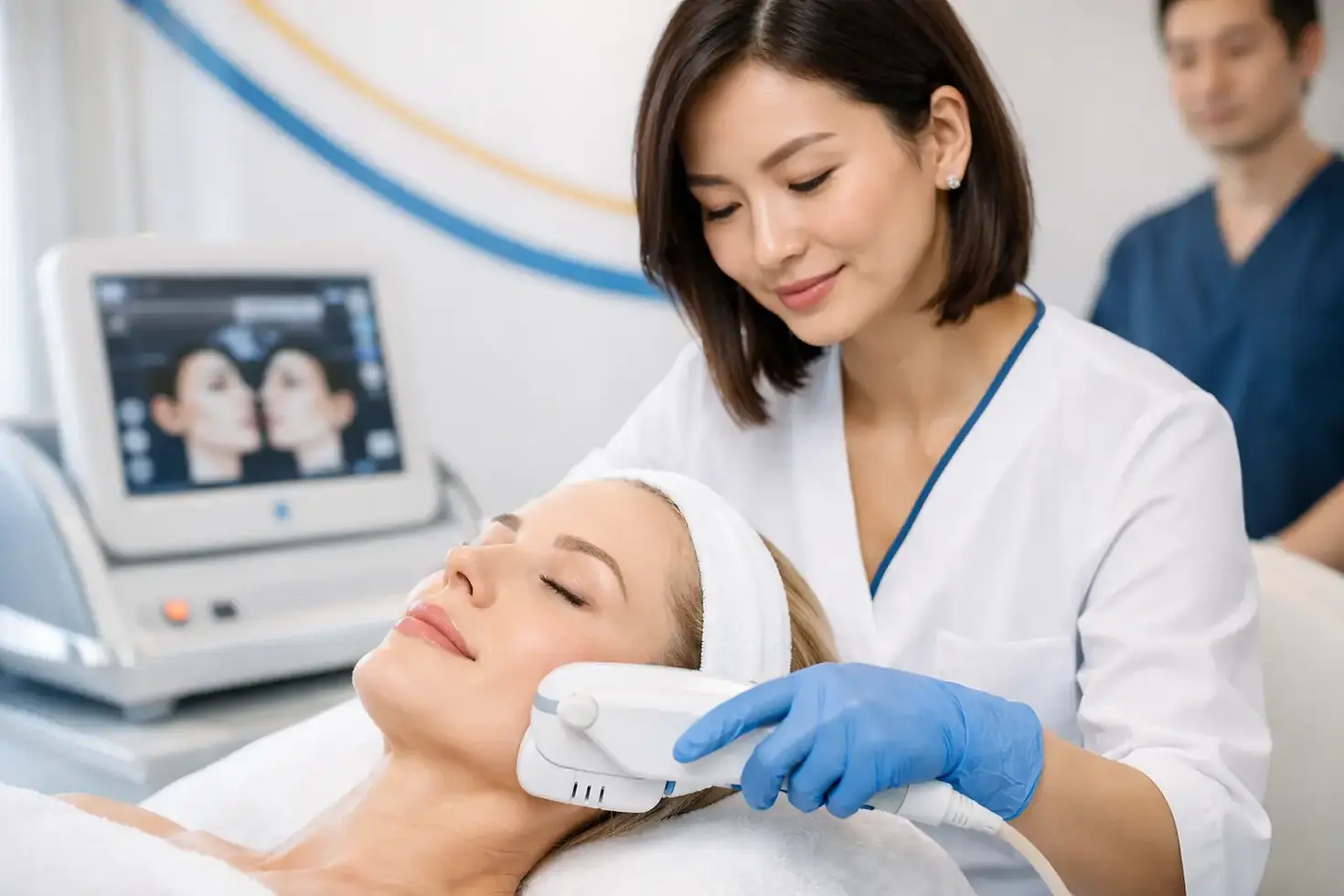
How HIFU Lifts Face Skin Naturally

Loose skin rarely appears all at once. Most patients notice it first in photos - a softer jawline, heavier nasolabial folds, or a tired look around the lower face despite good skincare. That is usually when the question comes up: how HIFU lifts face tissue without surgery, scars, or a long recovery.
HIFU, short for High-Intensity Focused Ultrasound, is a non-invasive treatment designed to tighten and lift by delivering focused ultrasound energy beneath the skin surface. Unlike creams or superficial facials, it works at structural depths that matter in facial aging. The goal is not to inflate the face or freeze expression. It is to stimulate a controlled healing response that gradually firms tissue and improves support.
How HIFU lifts face tissue
To understand how HIFU lifts face contours, it helps to understand where facial laxity begins. As we age, collagen declines, elastin weakens, and the fibromuscular support layers of the face become less taut. Skin starts to drape differently, especially along the cheeks, jawline, and under the chin.
HIFU targets specific depths under the skin using thermal coagulation points created by focused ultrasound energy. These micro-injury zones are precise and do not damage the skin surface. The heat stimulates neocollagenesis and tissue contraction in deeper layers, including the SMAS layer, which is the same foundational layer addressed during a surgical facelift.
That detail matters. Many non-invasive treatments improve skin quality, but not all reach the structural plane involved in sagging. HIFU is different because it is designed to work below the epidermis and dermis, where lifting support can be meaningfully improved.
The treatment does two things. First, it creates immediate collagen contraction, which can produce a subtle early tightening effect. Second, and more importantly, it triggers longer-term collagen remodeling over the next two to three months. That is why results tend to look progressive rather than sudden.
What areas of the face respond best to HIFU?
HIFU is most effective in patients with mild to moderate skin laxity. In clinical practice, the best treatment zones are usually the lower face and upper neck, where structural support loss is more obvious but not yet severe.
Common treatment areas include the jawline, jowls, cheeks, under-chin area, and brows. In the right patient, HIFU can create a more defined lower face, reduce early jowling, and give the face a firmer, more rested appearance. Brow lifting is also possible, especially when there is mild heaviness rather than significant excess skin.
What HIFU does not do is replace volume. If facial aging is driven more by fat pad loss than sagging, the patient may need a different approach, such as dermal fillers or collagen stimulators. This is where proper medical assessment matters. A face can look older because it has dropped, deflated, or both. Treating the wrong issue leads to disappointing results.
Why results look natural
One reason patients choose HIFU is that the change is gradual. There is no sudden shift in facial identity. Instead, the face looks firmer and more supported over time. Friends may notice you look fresher or slimmer through the jawline without immediately identifying a procedure.
That natural progression happens because your body is doing the lifting work through collagen regeneration. HIFU does not add bulk. It also does not depend on repeated muscle weakening, as neuromodulators do. It improves tissue quality and support, which is why the result can look refined rather than overdone.
This also means patience is part of the treatment. If someone wants a dramatic one-week transformation before a major event, HIFU is usually not the first choice. It is better suited for patients who want strategic tightening with little interruption to daily life.
What happens during treatment
A proper HIFU treatment starts with facial assessment, not machine settings. The doctor evaluates skin thickness, laxity, facial anatomy, degree of volume loss, and whether HIFU is the right tool for the concern. This matters because energy delivery must be planned according to treatment depth and target area.
During the procedure, ultrasound gel is applied and the handpiece is placed against the skin. Energy is then delivered in lines or passes across the selected zones. Patients usually feel heat, tingling, or a brief deep ache as the energy reaches the intended tissue planes. It is tolerable for most people, though comfort varies by area and by individual pain threshold.
Treatment time depends on the areas covered, but a full face and neck session often takes between 45 and 90 minutes. There is usually no open wound, no peeling, and no major visible aftercare. Mild redness, tenderness, or temporary swelling can occur, but downtime is minimal.
When you will see results
Some patients notice a slight tightening effect within days, but the more meaningful improvement develops gradually. Collagen remodeling takes time. Most patients begin to see clearer lifting and tightening around 8 to 12 weeks after treatment, with continued improvement for several months.
Longevity depends on age, baseline skin quality, lifestyle, and the degree of laxity being treated. For many patients, results last around 9 to 12 months, sometimes longer. Maintenance sessions may be recommended depending on how quickly the skin is aging and whether the treatment is part of a broader anti-aging plan.
This is also where expectations need to be realistic. HIFU can lift and tighten, but it will not recreate the result of surgery in someone with advanced sagging. The strongest outcomes are usually seen in patients treating early to moderate laxity before the skin has significantly descended.
Who is a good candidate?
The ideal candidate is someone who has started to notice softening of the jawline, mild jowling, cheek descent, or under-chin looseness, but does not want surgery. Patients in their thirties to fifties often respond well, although biological age matters more than chronological age.
HIFU is generally less effective when the skin is very loose, very thin, or heavily photoaged. It can also be less rewarding in patients expecting instant or dramatic lifting. In those cases, a doctor may recommend combination treatment or a different modality.
A physician-led plan is especially important if facial aging is mixed. For example, a patient may benefit from HIFU along the jawline, skin boosters for hydration and surface quality, and targeted injectables to restore structural balance. Modern aesthetic medicine is rarely about one treatment for everything.
Safety, device quality, and why expertise matters
HIFU is highly technique-dependent. The safety profile is strong when performed with appropriate patient selection, correct depth mapping, and medically sound energy parameters. However, not all devices are equal, and not all providers assess the face with the same level of anatomical understanding.
A premium clinic setting should prioritize certified medical oversight, approved technology, and treatment planning based on anatomy rather than sales packages. That is particularly important around sensitive areas such as the cheeks, temples, and jawline, where energy placement needs precision.
In experienced hands, side effects are usually limited to temporary tenderness, mild swelling, or transient numbness. Serious complications are uncommon, but they are best avoided through proper training, quality equipment, and a consultation that determines whether HIFU is actually appropriate.
HIFU versus other lifting treatments
Patients often compare HIFU with radiofrequency, thread lifts, fillers, and surgery. Each has a different purpose.
Radiofrequency can improve skin tightening and texture, often with a more superficial or diffuse heating pattern depending on the device. Thread lifts can create a more immediate repositioning effect, but they are minimally invasive and come with different risks and recovery considerations. Fillers restore volume, not true lift in every case. Surgical facelift remains the gold standard for advanced laxity.
So where does HIFU fit? It works best as a non-surgical collagen remodeling treatment for patients who want measurable tightening with minimal downtime and a natural timeline. For many, that makes it an excellent first-line option. For others, it is one part of a more complete rejuvenation plan.
At a medically supervised aesthetic clinic such as Dream Clinic, that distinction matters. Good outcomes come from choosing the right treatment, not simply the most popular one.
If your face looks tired because it is beginning to descend, early treatment is often the smartest move. HIFU works best when there is still enough skin resilience to respond - and that is exactly why timing, assessment, and expert planning make all the difference.


