
Titanium Lifting vs HIFU: Which Non-Surgical Lift Is Right for Your Face?

Updated: Mar 27

You've read conflicting advice. Some say HIFU is the gold standard for non-surgical facelifts. Others warn it hollowed their cheeks. Meanwhile, Titanium Lifting promises painless results. But is it just a rebranded hair removal laser?
The confusion exists because these technologies aren't interchangeable. They target different depths, address different aging patterns, and suit different patients.
The short answer: HIFU delivers focused ultrasound to the deep SMAS layer (4.5mm) for structural lifting of heavy, sagging tissue.
Titanium Lifting uses triple-wavelength diode lasers (755nm, 810nm, 1064nm) to heat the superficial dermis (1–3mm) for skin tightening and brightening.
HIFU suits "Saggers" with tissue descent. Titanium suits "Sinkers" with volume loss, or anyone who prioritizes comfort over intensity.
But the right choice depends on your facial anatomy, not marketing claims. That requires understanding why each technology works, who it's designed for, and what can go wrong when it's misapplied.
Quick Comparison: Titanium Lifting vs HIFU
Criteria | Titanium Lifting | HIFU |
Technology | Triple-wavelength diode laser | Focused ultrasound energy |
Target Depth | Superficial dermis (1–3mm) | Deep tissue + SMAS layer (1.5–4.5mm) |
Primary Effect | Skin tightening, brightening, collagen stimulation | Structural lifting, deep tissue remodeling |
Pain Level | Minimal (sapphire cooling) | Mild to moderate discomfort |
Downtime | None to minimal | Mild swelling/redness for 1–3 days |
Results Duration | ~6 months (maintenance-based) | 12–18 months |
Best For | Sinkers, pain-sensitive patients | Saggers, significant jowls |
Risk if Misapplied | Limited; primarily superficial | Cheek hollowing if fat pads are targeted |
This guide breaks down the science, the risks, and the decision framework. Walk into your consultation with clarity, not confusion.
How HIFU and Titanium Lifting Work
The key difference is depth.

HIFU delivers focused ultrasound to the SMAS layer at 4.5mm: the same structural layer surgeons target during facelifts.
When the SMAS loosens with age, tissue descends, creating jowls, nasolabial folds, and a softened jawline. HIFU tightens this layer from within, triggering neocollagenesis over 3–6 months.
Titanium Lifting uses triple-wavelength diode lasers (755nm, 810nm, 1064nm) to heat the superficial dermis at 1–3mm.
This stimulates collagen production and delivers immediate tightening, brightening, and improved skin texture. Results are visible same-day but require maintenance every 4–6 months.
In simple terms: HIFU lifts from the foundation up. Titanium tightens from the surface down.

Source: Dream Clinic Instagram
Learn more about why Soprano Titanium Lifting is taking Malaysia by storm.
Why Depth Matters for Safety
HIFU's 4.5mm depth sits near facial fat pads. If a practitioner uses cookie-cutter settings without assessing your anatomy, energy can damage fat tissue: causing the "cheek hollowing" you've read about online.
Titanium operates at 1–3mm, safely above the fat layer. Lower risk, but also unable to achieve HIFU's deep structural lift.
Neither is "better." They solve different problems at different depths.
Want to understand how HIFU rejuvenates skin at the cellular level? Explore our article on how HIFU treatment can rejuvenate your skin where we explain the science of focused ultrasound and collagen remodeling.
HIFU vs. Titanium Lifting: Which One Is More Painful?

HIFU involves mild-to-moderate discomfort. Most patients feel warmth, tingling, and occasional "zaps": especially on bony areas like the jawline. Pain scores typically range 4–6/10. Topical numbing cream (applied 30–45 minutes beforehand) makes it manageable. Sessions last 45–60 minutes.
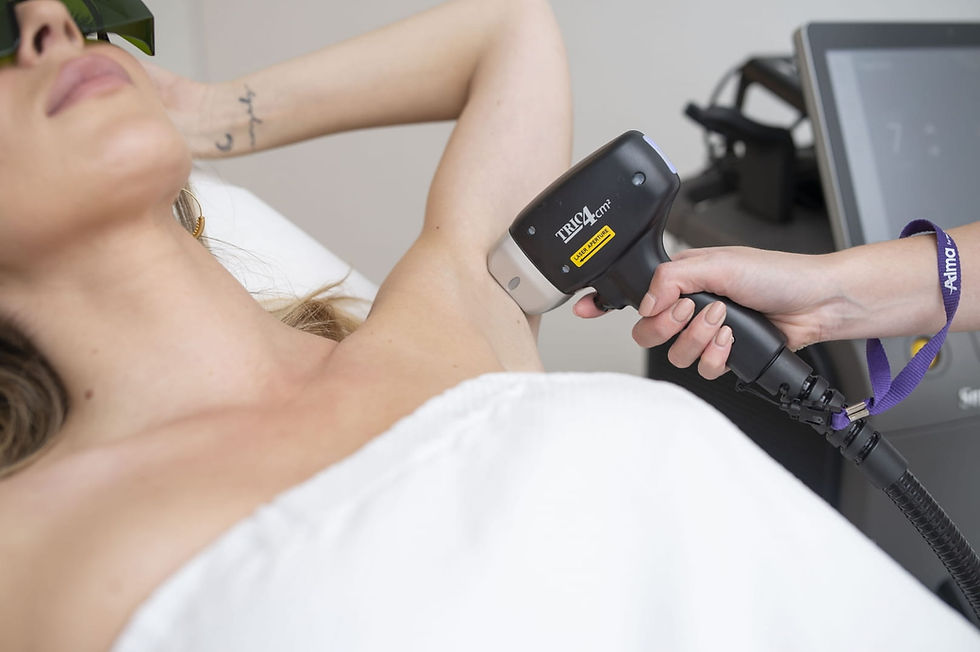
Titanium Lifting is nearly painless. The sapphire cooling tip chills the skin surface to 4°C while the laser heats below. Most patients compare it to a warm massage. No numbing required. Sessions take 30–45 minutes.
If horror stories about HIFU pain concern you, know that severe discomfort usually indicates overly aggressive settings or poor technique: not the technology itself.
Pain Comparison: Titanium Lifting vs HIFU
Factor | Titanium Lifting | HIFU |
During treatment | Warm massage sensation | Prickling, occasional zaps |
Pain score (avg) | 1–2 / 10 | 4–6 / 10 |
Numbing required | Usually not | Recommended |
Post-treatment | Mild redness (hours) | Mild tenderness (days) |
Will HIFU Hollow My Cheeks?
The fear is real: but cheek hollowing is preventable.
Cheek hollowing happens when HIFU energy hits facial fat pads instead of the SMAS layer. Fat cells are heat-sensitive; damage them, and the body absorbs them over weeks, creating a gaunt appearance.
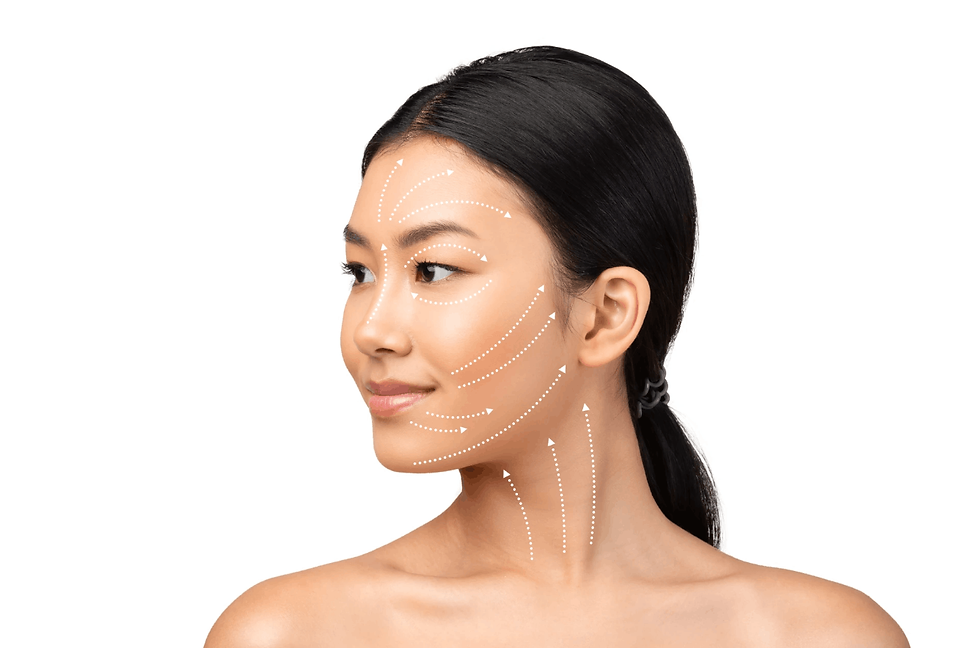
The cause isn't the technology. It's practitioners who apply the same 4.5mm cartridge to every face without assessing anatomy. Patients with low facial fat are especially at risk.
Titanium Lifting operates at 1–3mm: entirely within the dermis, safely above the fat layer. It physically cannot cause volume loss. The trade-off: it also cannot achieve HIFU's deep structural lift.
Questions to Ask Before Booking
"Do you perform a facial assessment before deciding on settings?"
"How do you adjust HIFU depth for patients with low facial fat?"
"Are your doctors LCP-certified?"
If a clinic dismisses these questions, reconsider.
Red Flags vs Green Flags
🚩 Red Flags | ✅ Green Flags |
Same protocol for every patient | Personalized facial assessment first |
Dismisses volume loss concerns | Explains Sinker vs Sagger profiles |
Operated by therapists, not doctors | LCP-certified doctors |
Sinker vs Sagger: Which Profile Are You?
Faces age in two primary patterns.
"Sinkers" lose volume: fat pad atrophy, collagen loss, and bone resorption create a hollow, gaunt appearance. Visible in cheeks, temples, and under-eyes. If people ask "are you tired?" when you're not, you may be a Sinker.
"Saggers" retain volume but lose structural support: the SMAS layer weakens, tissue migrates downward, creating jowls, nasolabial folds, and a softened jawline. If your face looks heavier when you tilt forward, you may be a Sagger.
Most patients 40+ exhibit both patterns. One usually dominates.
📋 Which Profile Fits You?
Check the statements that apply to you:
Interpreting Your Results:
Mostly Sinker signs? → Titanium Lifting is likely your safer starting point. Avoid aggressive HIFU on the mid-face. Consider combining with fillers or biostimulators for volume restoration.
Mostly Sagger signs? → HIFU is likely your most effective option for structural lifting. Your facial fat reserves provide a safety buffer for deeper energy delivery.
Mixed results? → You're a hybrid (most people are). A personalised facial mapping consultation will clarify which treatment — or combination — suits your specific anatomy.
Not sure? → That's exactly what consultations are for. Book a no-obligation assessment with our doctors.
Why This Matters for Treatment Choice
Sinkers risk worsening with aggressive HIFU. Less subcutaneous fat means 4.5mm energy can deplete what little remains. The priority is volume restoration (Profhilo, fillers) combined with Titanium's surface tightening: not deep structural lifting.
Saggers benefit most from HIFU. Deep SMAS targeting lifts descended tissue, redefines the jawline, and reduces jowl heaviness. With adequate fat reserves, HIFU tightens rather than depletes.
Hybrid patients (most people) often need combination protocols: HIFU for jawline/neck, Titanium for cheeks/periorbital, fillers for temples.
Another Test to Identify Your Pattern (Mirror Test)
Stand in good lighting. Tilt your face 45° down: if it looks heavier/droopier, you have a Sagger component. Look straight ahead: if cheeks appear hollow or temples sunken, you have a Sinker component. Note which bothers you more.
The mirror test isn't diagnostic: it's a conversation starter for your consultation.
Decision Framework
Choose HIFU if you:
Have heavy, drooping tissue (Sagger)
Have adequate facial fat reserves
Can tolerate mild discomfort
Want results lasting 12–18 months
Choose Titanium if you:
Have volume loss concerns (Sinker)
Are pain-sensitive
Prefer maintenance-based approach
Want immediate results with zero downtime
Unsure which profile fits you?
Our doctors can assess your facial anatomy in person and tell you exactly whether HIFU, Titanium Lifting, or a combination approach suits your face. Book a no-obligation consultation via WhatsApp.
Not ready yet? Read our guide on signs of skin aging helps you identify whether you're dealing with volume loss, texture changes, or structural descent.
How Long Do Results Last?
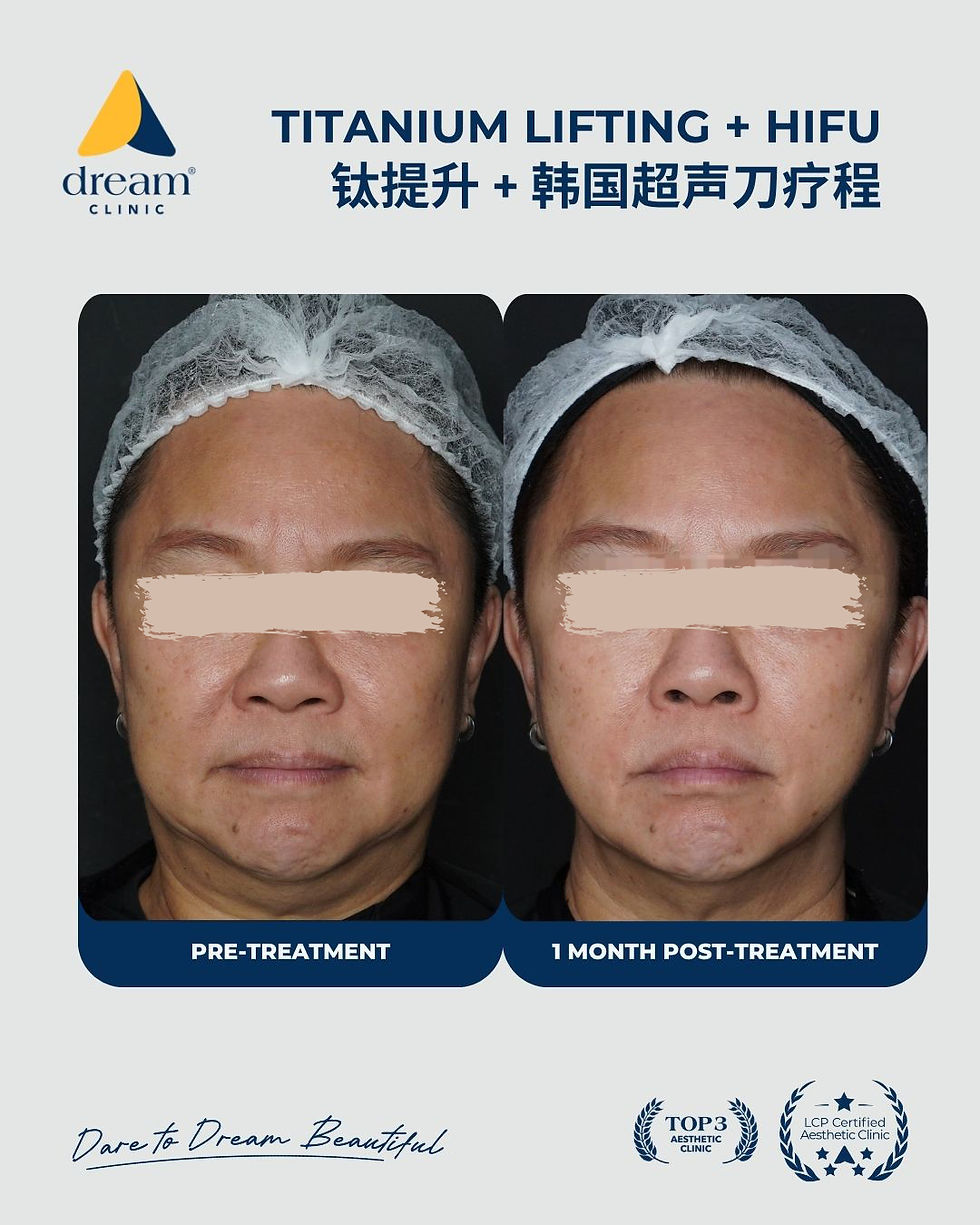
HIFU: Results develop gradually over 3–6 months as the SMAS layer remodels and new collagen forms. Peak results typically last 12–18 months. Planning for an event? Book 3–6 months ahead, not 3 weeks.
Titanium: Immediate visible tightening, brightening, and glow. Collagen remodeling continues 4–8 weeks post-treatment. Optimal results require 3–4 initial sessions, with maintenance every 4–6 months.
Think of it this way: Titanium is like a gym membership (consistent sessions compound). HIFU is like a renovation (intensive, infrequent, long-lasting).
Realistic expectations: Non-surgical treatments deliver improvement, not transformation. HIFU produces 20–30% improvement in skin laxity and noticeable jawline definition. Titanium produces visibly tighter, brighter skin with refined pores.
Results Timeline
Milestone | Titanium Lifting | HIFU |
Immediate | Visible tightening & glow | Mild redness/swelling |
2–4 weeks | Collagen stimulation begins | Initial tightening noticeable |
3–6 months | Maintenance session recommended | Peak results achieved |
12–18 months | Multiple sessions completed | Maintenance session recommended |
Exploring all your face lifting options? Compare HIFU and Titanium with other modalities in our comprehensive guide to best face lifting treatments available in Malaysia.
What Are the Treatment Processes for Titanium Lifting and HIFU?
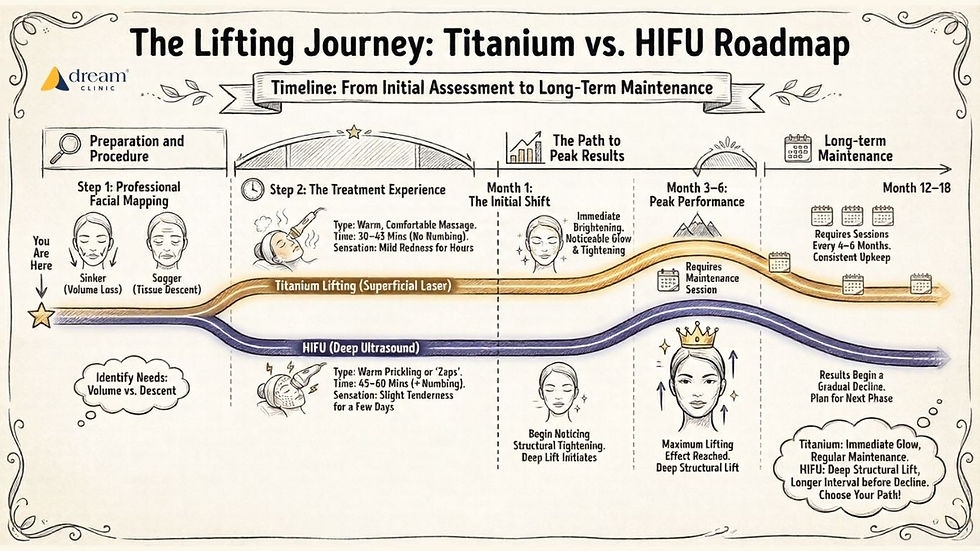
Both treatments are outpatient procedures with no general anesthesia required. Here's what to expect:
Treatment Experience Comparison
Stage | Titanium Lifting | HIFU |
Preparation | Clean face, no numbing needed | Clean face + numbing cream (30–45 min) |
Duration | 30–45 minutes | 45–60 minutes |
Sensation | Warm massage, relaxing | Prickling, occasional zaps |
Immediately after | Mild redness (hours), immediate glow | Mild redness/swelling (1–3 days) |
Aftercare | Normal routine, SPF | Avoid heat 24–48 hrs, SPF |
Results visible | Same day | 3–6 months |
Next session | 4–6 weeks (series of 3–4) | 12–18 months |
Before booking: Every treatment begins with consultation and facial mapping. Your doctor assesses fat pad distribution, skin laxity, and aging pattern to determine settings. Clinics that skip this step should be avoided.
Contact your clinic if you experience: severe pain, significant swelling/bruising, blistering, or numbness lasting more than a few weeks.
Confused between HIFU, Fotona, Titanium Lifting or OligioX?
How to Choose the Right & Safe Aesthetic Clinic for Titanium Lifting or HIFU
Before booking Titanium Lifting or HIFU anywhere, look for these signals:
🚩 Red Flags (Walk Away) | ✅ Green Flags (Good Signs) |
Same treatment protocol for every patient | Personalised facial assessment before treatment |
Dismisses your concerns about pain or side effects | Explains pain management options and sets realistic expectations |
Vague about practitioner qualifications | Doctors are LCP-certified and credentials are verifiable |
Pushes one treatment regardless of your concerns | Offers multiple options and recommends based on your anatomy |
No consultation — jumps straight to booking | Thorough consultation before any commitment |
Unclear about device authenticity | Uses FDA-approved devices and can show certification |
No post-treatment support mentioned | Clear aftercare instructions and follow-up protocol |
Promises dramatic, guaranteed results | Honest about realistic outcomes and limitations |
Pressures you to decide immediately | Gives you time to consider without pressure |
The Bottom Line: A good clinic welcomes your questions. If asking about credentials, devices, or protocols makes them defensive, that tells you everything you need to know.

Why Choose Dream Clinic
Dream Clinic offers both Titanium Lifting and HIFU (Ultracel Q+). Most clinics invest in one technology and push it regardless of suitability. Because we offer both, our recommendations are genuinely unbiased.

Why Patients Trust Us
✅ Both technologies available: recommendations based on your face, not our inventory
✅ LCP-certified doctors: all treatments performed by MOH-credentialed aesthetic doctors, not therapists
✅ Personalized facial mapping: fat pad assessment, Sinker vs Sagger profiling before every session
✅ FDA-approved devices only: genuine Ultracel Q+ (Jeisys, Korea) and Soprano Titanium (Alma Lasers, Israel)
✅ 500+ five-star Google reviews: organic feedback from real patients
✅ Multi-location: Penang, KL (Bukit Jalil), and soon Johor
The Bottom Line
HIFU and Titanium Lifting solve different problems at different depths.
HIFU delivers focused ultrasound to the SMAS layer (4.5mm), triggering neocollagenesis and structural lifting over 3–6 months.
It's built for Saggers with tissue descent, adequate fat reserves, and tolerance for mild discomfort. Results last 12–18 months.
Titanium Lifting delivers triple-wavelength laser energy (755nm, 810nm, 1064nm) to the superficial dermis (1–3mm), producing immediate tightening and glow with virtually no pain.
It's built for Sinkers with volume loss concerns, or anyone who prefers maintenance-based care over intensive intervention.
Neither replaces the other. Many patients benefit from combining both: HIFU for foundation, Titanium for finish.
The deciding factor isn't which machine is "better." It's whether your face needs deep structural remodeling, surface tightening, or a layered approach addressing both.
That answer requires a facial mapping assessment with a doctor who offers both technologies and has no incentive to push one over the other.

Not sure if you're a Sinker, a Sagger, or somewhere in between?
Book a personalized facial mapping consultation with our LCP-certified doctors.
We'll assess your facial anatomy, discuss your goals, and recommend the right treatment: whether that's Titanium Lifting, HIFU, a combination protocol, or something else entirely.
No pressure. No obligation. Just clarity.
FAQs
Q1. Is Titanium Lifting safe for darker skin tones?
Yes. The 1064nm wavelength is melanin-safe and suitable for Asian and darker skin tones. However, improper settings can cause transient hyperpigmentation: choose an experienced practitioner.
Q2. Can I combine Titanium Lifting and HIFU?
Yes: many doctors recommend it. HIFU addresses deep structural lifting while Titanium tightens the surface. This layered approach often produces superior results.
Q3. Is HIFU suitable for patients in their 30s?
Yes, if there's visible sagging. However, many 30s patients with mild laxity find Titanium sufficient for maintenance. Your doctor will advise based on your anatomy.
Q4. Who should NOT get HIFU?
Patients with very low facial fat (risk of hollowing), active skin infections, or severe sagging better suited for surgery. Not recommended during pregnancy.
Q5. Who should NOT get Titanium Lifting?
Patients with active skin infections, open wounds, or extreme photosensitivity. Those seeking dramatic structural lifting may find Titanium insufficient.
Q6. Which treatment gives faster results?
Titanium delivers immediate visible tightening. HIFU results develop over 3–6 months. For an event soon, choose Titanium.
Q7. What questions should I ask before booking HIFU?
Ask: "Do you perform a facial assessment first?" "How do you adjust settings for low facial fat?" "Are your doctors LCP-certified?" "Is this an FDA-approved device?"
Q8. Why does Dream Clinic offer both Titanium and HIFU?
So recommendations are unbiased. We have no financial incentive to push one technology: we recommend what's right for your face.
How We Created This Guide
This comparison was developed by Dream Clinic's medical content team in consultation with our LCP-certified aesthetic doctors.
Information is based on:
Clinical experience with both Ultracel Q+ HIFU and Soprano Titanium Lifting
Manufacturer specifications from Jeisys and Alma Lasers
Peer-reviewed literature on focused ultrasound and diode laser therapy
Real patient feedback
We update this guide periodically as new clinical evidence emerges.
Dream Clinic offers both technologies discussed in this article. Our recommendations are based on individual patient assessment, not commercial preference.
Still researching?
Follow Dream Clinic on Instagram for real patient transformations, treatment explanations, and behind-the-scenes looks at our clinic.
When you're ready to take the next step, we'll be here.
References
1. Alam, M., White, L. E., Martin, N., Witherspoon, J., Yoo, S., & West, D. P. (2010). Ultrasound tightening of facial and neck skin: A rater-blinded prospective cohort study. Journal of the American Academy of Dermatology, 62(2), 262–269. https://doi.org/10.1016/j.jaad.2009.06.039
2. Fabi, S. G. (2014). Noninvasive skin tightening: Focus on new ultrasound techniques. Clinical, Cosmetic and Investigational Dermatology, 7, 47–52. https://doi.org/10.2147/CCID.S69118
3. Jeisys Medical. (n.d.). ULTRAcel Q+ product information. Jeisys Global. https://jeisys-inc.com/products/ultracelq/
4. Lee, H. S., Jang, W. S., Cha, Y. J., Choi, Y. H., Tak, Y., Hwang, E., Kim, B. J., & Kim, M. N. (2012). Multiple-pass high-intensity focused ultrasound for skin tightening: A split-face study. Dermatologic Surgery, 38(7 Pt 1), 1022–1029.
5. Park, J. H., Choi, W. S., Kim, W. S., & Kim, B. J. (2015). High-intensity focused ultrasound for the treatment of wrinkles and skin laxity in seven different facial areas. Annals of Dermatology, 27(6), 688–693. https://doi.org/10.5021/ad.2015.27.6.688
6. Suh, D. H., Shin, M. K., Lee, S. J., Rho, J. H., Lee, M. H., Kim, N. I., & Song, K. Y. (2011). Intense focused ultrasound tightening in Asian skin: Clinical and pathologic results. Dermatologic Surgery, 37(11), 1595–1602.
7. Tsagkataki, M., et al. (2025). Complications and risks of high-intensity focused ultrasound (HIFU) in esthetic procedures: A review. Applied Sciences, 15(9), 4958. https://doi.org/10.3390/app15094958
8. Alma Lasers. (n.d.). Soprano Titanium Special Edition. Alma Lasers. https://almalasers.com/product/soprano-titanium-special-edition/


