
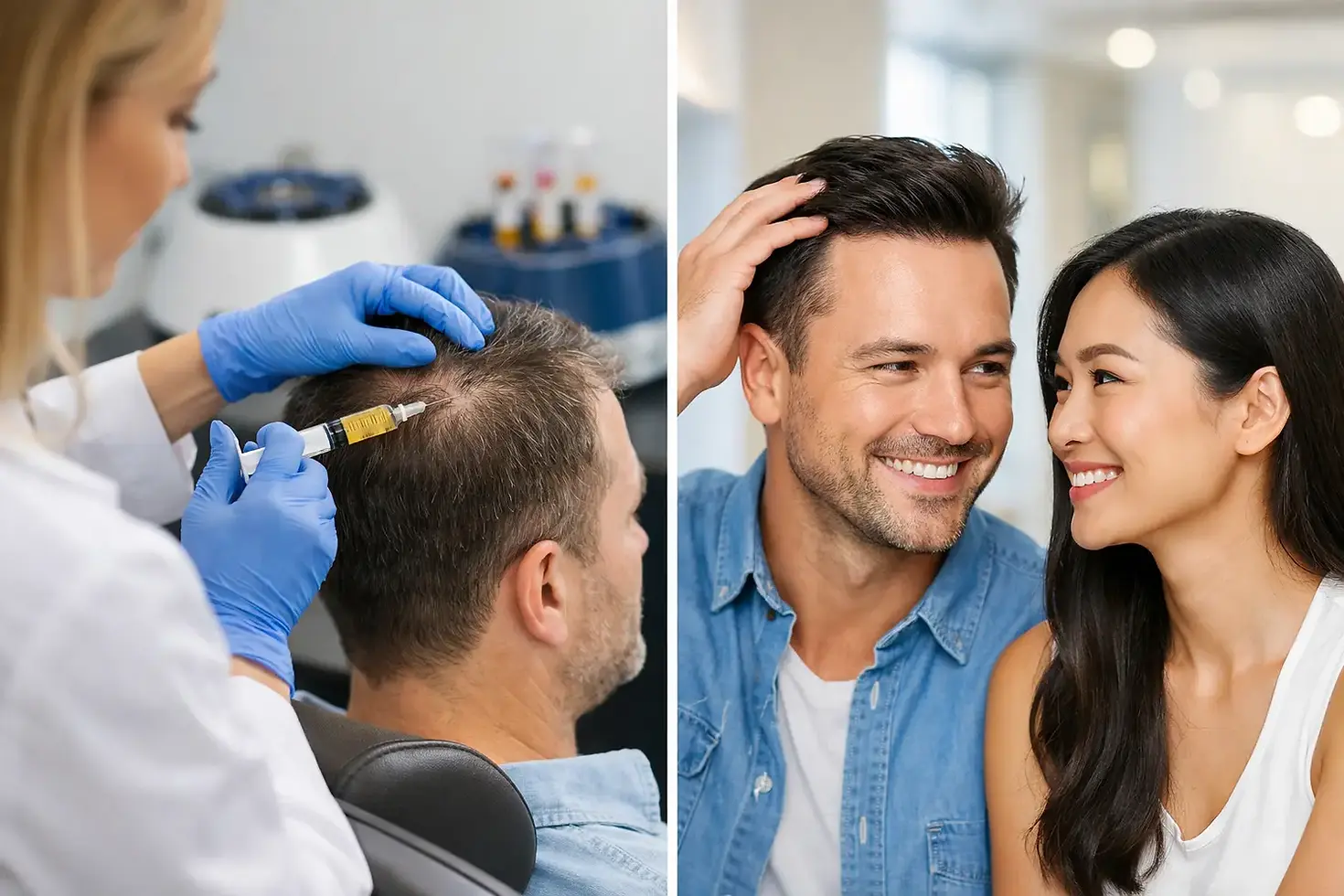
Hair PRF Before After: What to Expect

When patients ask about hair prf before after results, they are usually not asking for marketing photos. They want to know one thing - when will their hair actually look better, and how much better can they realistically expect it to be.
That is the right question. PRF for hair restoration can improve density, support weaker follicles, and slow progressive thinning, but the timeline is gradual and the final result depends on the cause of hair loss, the stage of miniaturization, and the quality of the treatment plan. If you are expecting overnight regrowth, you will be disappointed. If you understand what PRF is designed to do, the changes can be very worthwhile.
Hair PRF before after: what really changes
PRF stands for platelet-rich fibrin. It is prepared from your own blood and contains a concentrated mix of platelets, growth factors, fibrin matrix, and signaling cells that may support tissue repair and follicle activity. In hair restoration, PRF is injected into areas of thinning scalp to create a more favorable environment for follicles that are still alive but underperforming.
That distinction matters. PRF does not create brand-new follicles where none exist. It works best when follicles are dormant, miniaturized, or weakened, not fully absent. This is why hair PRF before after improvements are usually strongest in patients with early to moderate thinning rather than long-standing bald areas with a smooth, shiny scalp.
What changes first is not always what patients expect. Often, the earliest improvement is reduced hair shedding. Then hair may start to feel stronger, look less wispy, and appear to have better coverage in photographs. True density changes take longer because hair grows in cycles, and biology does not rush for anyone.
The typical PRF hair timeline
In the first one to two weeks after treatment, most patients do not see visible growth. The scalp may feel mildly tender for a day or two, and there can be tiny injection marks or mild redness. This is normal and usually short-lived.
Between weeks three and eight, some patients notice less shedding during washing or brushing. This phase is encouraging, but it can still be visually subtle. You may feel that your hair is easier to style or that the part line looks slightly less wide under bright light.
From around two to four months, early visible changes can begin. Baby hairs may appear in some areas, and existing strands may look thicker. This stage is where before-and-after comparisons become more meaningful, although results still tend to be modest rather than dramatic.
By four to six months, the difference is often clearer. Patients may report improved overall density, better scalp coverage, and less see-through thinning at the crown or temples. Those who started treatment earlier usually see more rewarding outcomes than those who waited until advanced loss had already set in.
For many patients, a series of sessions produces better results than a single treatment. Maintenance sessions may also be recommended because androgenetic hair loss is an ongoing process, not a one-time event.
What affects hair PRF before after results
The most important variable is diagnosis. PRF can be helpful for androgenetic alopecia, early thinning after stress-related shedding, and some cases of diffuse hair weakening. It may be less effective if the underlying issue is severe nutritional deficiency, active scalp inflammation, autoimmune hair loss, hormonal imbalance that is not addressed, or scarring alopecia.
The second major factor is timing. Hair follicles gradually miniaturize over time. The earlier you intervene, the more salvageable those follicles tend to be. Patients who seek treatment when they first notice widening parts, increased shedding, or reduced volume often respond better than those with extensive long-term loss.
Technique also matters. PRF preparation protocols, injection depth, treatment spacing, and doctor assessment all influence outcomes. This is one reason medically supervised treatment is important. A proper consultation should evaluate scalp condition, distribution of thinning, family history, recent illness, stress, hormonal factors, and whether combination therapy may be more appropriate.
Your home care and general health matter too. Poor sleep, smoking, crash dieting, iron deficiency, and unmanaged stress can work against your results. Hair is not separate from the rest of your biology.
Who tends to see the best before and after improvement
The best candidates are men and women with early to moderate thinning who still have active follicles in the treatment area. Women with diffuse volume loss often appreciate PRF because the goal is not an artificial look, but stronger, healthier, fuller hair over time. Men with early crown thinning can also respond well, especially when PRF is started before the scalp becomes sparsely populated.
Patients seeking a natural, minimally invasive option are often good candidates too. Because PRF is autologous, meaning it comes from your own blood, it avoids the synthetic component that some patients prefer to limit. That said, natural does not mean casual. Injection-based treatments should still be performed under proper medical protocols with careful patient selection.
When before and after photos can be misleading
Hair restoration photos are notoriously easy to manipulate without technically editing them. Different lighting, wet versus dry hair, camera angle, hair length, styling products, and even whether the hair is freshly colored can all change the appearance of density.
That is why standardized photography matters. Good clinical comparison photos use the same angle, same lighting, same hairstyle, and similar hair length. If you are judging your own progress, try not to compare a bad hair day from six months ago with a freshly blow-dried result today. Use consistent photos under the same conditions.
Another point patients do not always hear: improvement can be meaningful without looking dramatic online. A 15 to 25 percent density improvement in the right area can make styling easier and scalp show-through much less obvious. Real-world satisfaction and social media impact are not always the same thing.
PRF vs PRP for hair loss
Patients often compare PRF with PRP because both use your blood-derived growth factors. PRP is platelet-rich plasma, while PRF contains a fibrin matrix and is typically prepared without anticoagulants. This can allow slower release of growth factors and may offer theoretical regenerative advantages.
In practice, both treatments have a place in hair restoration. The better option depends on protocol, equipment, physician experience, and patient goals. PRF is often positioned as a newer-generation regenerative injectable, but it should not be framed as magic. The quality of assessment and treatment planning still matters more than trendy terminology.
What PRF can and cannot do
PRF can improve the environment around weakened follicles, potentially reduce shedding, and support better hair caliber and density over time. It may help hair look fuller, healthier, and more resilient.
It cannot reliably restore a completely bald scalp to teenage density. It cannot overcome untreated medical triggers. And it may not be enough as a standalone treatment for every patient.
This is where a more complete plan becomes valuable. Some patients benefit from combining PRF with topical or oral medications, microneedling, scalp health management, or energy-based treatments depending on the diagnosis. A premium clinic should not force every patient into the same protocol. It should explain what is realistic for your pattern of loss.
How many sessions are usually needed
A common starting protocol is a series of three to four sessions spaced several weeks apart, followed by maintenance every few months depending on response and the severity of hair loss. Some patients notice visible change after the second session, while others need more time.
This is not a sign that the treatment failed. Hair biology is slow, and response varies. The right way to judge treatment is over months, not days.
Is there downtime?
Downtime is minimal for most patients. You may have mild soreness, pressure sensitivity, or pinpoint injection marks for a short period. Many return to normal activities quickly, though your doctor may advise avoiding intense workouts, excessive heat, or harsh scalp products for a day or two.
The low downtime is one reason PRF appeals to busy professionals who want treatment that fits into real life. In cities such as Kuala Lumpur or Penang, where schedules are packed and appearance still matters in work and social settings, that practicality counts.
The right expectation leads to better satisfaction
The most satisfied patients are rarely the ones chasing instant transformation. They are the ones who understand that PRF is a regenerative treatment, not a cosmetic cover-up. They value steadier shedding control, stronger strands, and gradual visible improvement that still looks like their own hair.
That is the real value of hair PRF before after results. Not a sudden miracle, but a medically guided change that can shift the trajectory of thinning hair while follicles are still worth saving.
If you are considering treatment, the smartest first step is not asking whether PRF works in general. It is asking whether it is the right treatment for your specific pattern of hair loss, at this stage, with a plan built around realistic outcomes.


